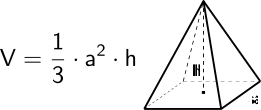
Volume of a Pyramid The volume of a pyramid is the space it occupies in a 3-dimensional plane. It is expressed in cubic units such as m 3, cm 3, mm 3, and in 3. Formulas The general formula to find the volume of any pyramid is: Volume (V) = 1 3 B h, here B = base area, h = height
To calculate the volume of a pyramid, you need to know its height and the area of the base. Once you have that information, you can find the volume using the formula V (volume) = 1/3 x Ab (the area of the base) x h (height).
The formula for the volume of a pyramid is equal to one-third of the product of the base area and the height of the pyramid and is usually represented by the letter "V".
What Is the Formula To Find the Volume of Pyramid? The volume of a pyramid is found using the formula V = (1/3) Bh, where 'B' is the base area and 'h' is the height of the pyramid.
The volume of a pyramid that has the same base and height as the prism it is inscribed in is exactly one-third the volume of the prism. This is true for any pyramid that can be inscribed in a prism as long as the base and height are the same.
Volume of a pyramid formula Suppose B is the area of the base, h is the height of the pyramid, and V is the volume. Then, Volume = (B × h)/3 = Bh/3 In general, the volume of a pyramid is one third the product of the base area and the height of the pyramid. The volume is expressed in cubic units.
To find the volume of a pyramid, we need to know the total capacity of the given pyramid. The formula for the pyramid’s volume is given by one-third of the product of the area of the base to its height.
The formula for the volume of a pyramid is, in the most general form, $$V = \frac {1} {3}Bh$$ where B is the area of the base (regardless of its shape), and h is the height from the base to the apex. This also applies to cones.