Proportion is a mathematical comparison between two numbers. According to proportion, if two sets of given numbers are increasing or decreasing in the same ratio, then the ratios are said to be directly proportional to each other.
Proportion (mathematics) A proportion is a mathematical statement expressing equality of two ratios. [1][2] a and d are called extremes, b and c are called means. Proportion can be written as , where ratios are expressed as fractions.
A proportion is a statement that says that two ratios are equal. They can be used in many everyday situations like comparing sizes, cooking, calculating percentages, and more.
A proportion is an equality between two ratios or fractions. If x, y, z, and w are in proportion, then x:y::z:w or x y:: z w, here x y, z w are equivalent ratios, and ‘::’ is the symbol of proportion. Thus, two equivalent ratios form a proportion. The terms y and z are called mean terms, and x and w are extremes.
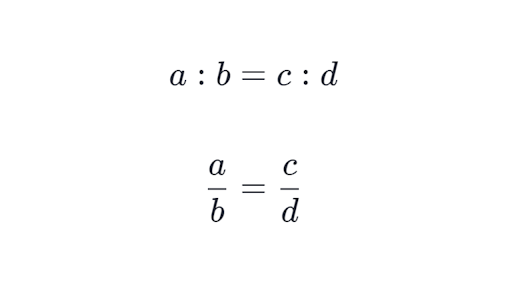 A proportion is an equality of two ratios. We write proportions to help us establish equivalent ratios and solve for unknown quantities.